
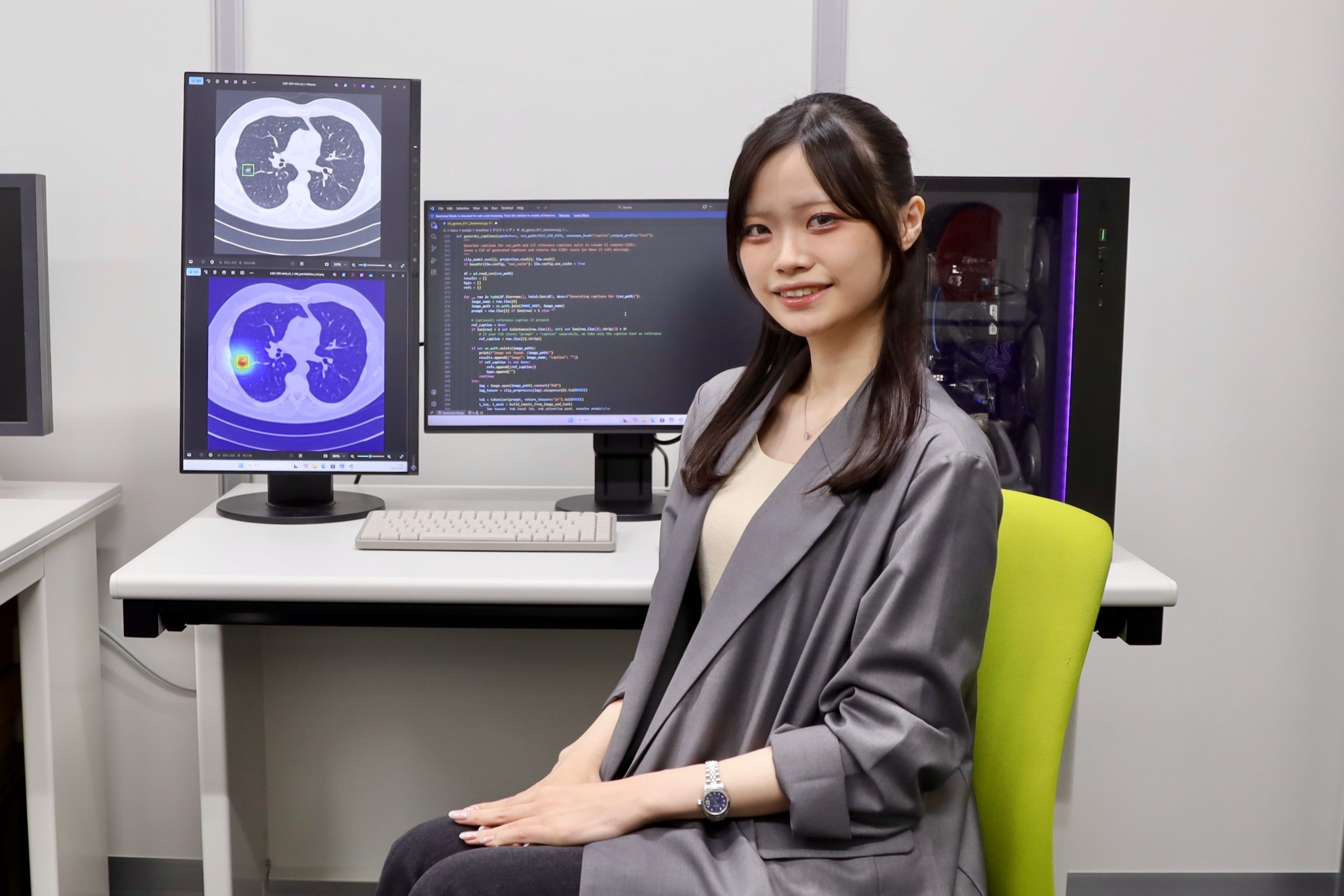
Graduated from Fujita Health University and entered Meijo University for graduate study, where she joined the laboratory of Professor Atsushi Teramoto. Drawing on her medical knowledge and the latest vision-language AI technologies, she is engaged in research on diagnostic imaging systems that support both patients and physicians.
We spoke with her about what motivated her to transition from a medical science background to graduate study at Meijo University, her research and student life in graduate school, and her future goals.
Maiko Nagao
Could you tell us about any achievements or research accomplishments from your undergraduate years that you are particularly proud of?
At the university I attended, most courses were mandatory, so weekdays were packed with classes, and before exams, there was always a huge amount to memorize. In addition, there were periods when we had laboratory sessions running from first period through fifth period several times a week, along with hospital training placements, so I was constantly occupied with reports and assignments.
Even in that environment, I believe one of the things I truly gained during my undergraduate years was the ability to face each task seriously and see it through to the end.
Could you tell us why you decided to pursue a master’s degree and why you chose Meijo University for graduate school?
The reason I decided to pursue a master’s degree is that I wanted to explore the research I truly care about in greater depth. When I was in high school, a doctor once told my father that he might have lung cancer. However, because he was already suffering from another illness at the time, it was difficult for him to undergo invasive procedures such as a biopsy, which would have been necessary for a definitive diagnosis.
That experience led me to wonder whether there might be ways to support lung cancer diagnosis with less physical burden on patients. While looking into the topic, I learned that Professor Atsushi Teramoto’s laboratory was conducting research on AI-assisted cancer diagnosis, and I became strongly interested in being involved in such work myself.
Coming from a medical science background, I felt that Meijo University offered an environment where I could acquire knowledge and skills in information engineering while actively engaging in medical AI research. That is why I decided to pursue graduate studies there.
Could you explain the research theme you are currently working on?
I am currently developing lung cancer diagnostic support technology using vision-language AI models. Early detection and treatment are crucial for lung cancer, yet accurate diagnosis based solely on imaging data such as X-rays and CT scans remains a major challenge.
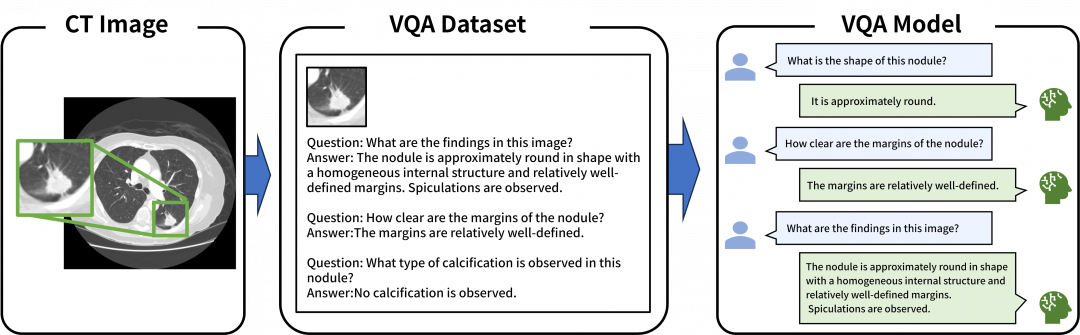
To address this issue, my research focuses on developing technology to automatically generate diagnostic reports from chest CT images and classify pulmonary nodule as benign or malignant. In addition, rather than simply generating text, I am developing an interactive system called Visual Question Answering (VQA) that can answer questions based on information contained in medical images.
What do you find most interesting or rewarding about this research topic?
I think one of the most fascinating aspects of this research is its ability to explain, in words, the reasoning behind AI decisions that would otherwise remain a “black box.” For example, in a court case, if a verdict simply stated “guilty” without explaining the reasons or evidence behind the decision, no one would be convinced. What matters is which evidence led to that conclusion and why.
The same applies to medical AI. Even if an AI system classifies a tumor as “benign” or “malignant,” physicians cannot fully trust the result unless they understand the basis for the decision. My research aims to present, in a clearer way, which parts of an image the AI focused on and which features it used as the basis for its judgment.
What I find especially compelling about this research is the opportunity to examine how AI “looks at” medical images and how it interprets and understands them.
On the other hand, could you tell us about any difficulties you have faced or any memorable failures along the way?
One of the biggest challenges for me has been that I come from a medical-science background rather than an information-engineering one, so it takes time to understand technical topics such as programming and AI. When I first started my research, I often could not immediately follow senior students’ presentations or fully understand what professors were discussing, which made me keenly aware of my lack of knowledge.
Still, whenever I encounter something I do not understand, I first try to research it on my own. If I still have difficulty understanding it, I ask professors, senior students, or classmates for help and work through it step by step. Even now, there are many things I find challenging, but I also feel that I am gradually deepening my understanding and growing in the field.
Could you tell us about any achievements or awards you have received during your first year after enrolling?
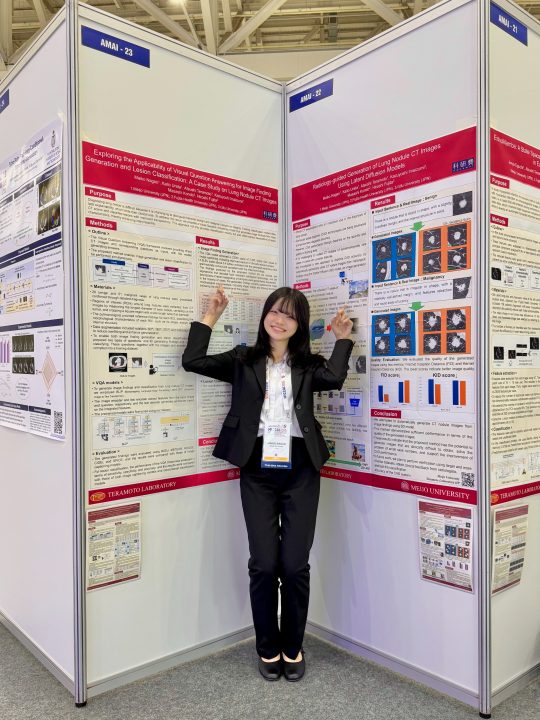
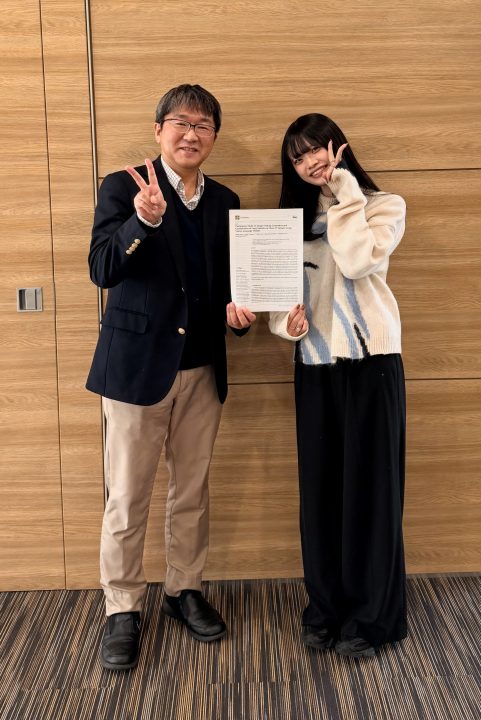
During my first year in the program, two of my first-author papers were published in international peer-reviewed journals, with me as the first author. In addition, I presented my research at two international conferences and six domestic conferences, continuously sharing the results of my work.
Among these achievements, receiving the Research Encouragement Award at the Tokai Branch Meeting of the Japanese Society for Medical and Biological Engineering was especially encouraging for me. Looking back, I feel it was a year in which I was able to produce tangible outcomes through my research in many different ways.
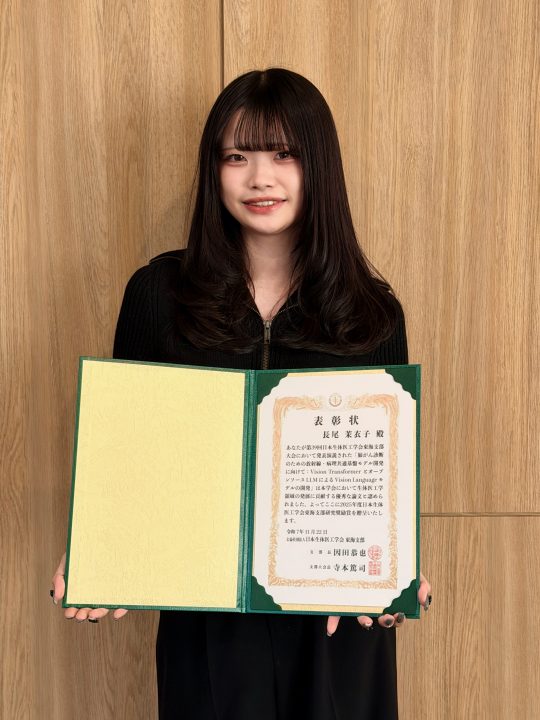
I heard that you also worked on writing papers in English. How was that experience? And what would you like to take on next?
As for writing papers in English, I was not particularly uncomfortable with writing itself to begin with, so I did not struggle too much in that regard. On the other hand, when it came to the technical aspects of information engineering and AI, I still needed to deepen my understanding as I wrote, which I found quite challenging. At the same time, going through the peer-review process allowed me to notice points I had overlooked and to reexamine my research from new perspectives. I feel it gave me a valuable opportunity to look at my work more objectively and from a broader perspective.
The next thing I would like to focus on is improving my ability to communicate my research findings more clearly and accurately in English. Through writing papers and giving conference presentations, I hope to become better at conveying both the significance and the appeal of my research.
Aside from your research, are there any other things you are focusing on or skills you would like to develop during your time as a student?
At the moment, I spend most of my time on research, so I would not say I have much time to devote to other things. However, the skills I especially want to strengthen while I am still a student are my knowledge of information engineering and my programming abilities.
Since information engineering was not originally my field of specialization, I would like to continue improving both my technical understanding and my implementation skills.
Looking back on your undergraduate years, is there anything you are glad you did, or anything you wish you had done differently?
One thing I wish I had done more of during my undergraduate years is studying English. When I gave a presentation at an international conference, I found it difficult to convey exactly what I wanted to say, which made me realize I should have improved my English skills earlier.
In research, it is important not only to read academic papers but also to communicate your own ideas in English through presentations and Q&A discussions. For that reason, I believe that gradually building English proficiency during undergraduate study can be extremely valuable for future research activities.
Could you tell us about your typical daily or weekly routine? Also, how do you usually spend your days off?
I am not much of a morning person, so I often go to the laboratory around midday and stay there until late at night. Even after returning home or on weekends, I usually spend much of my time doing research. However, when I am not busy with conferences or paper deadlines, I enjoy spending time with friends or going on trips. I have also played the piano since I was very young, so I still occasionally play it to relax and unwind.
Where do you think you will be, and what do you think you will be doing, ten years from now?
I cannot yet clearly picture where I will be in ten years, but the research I am currently working on is personally very meaningful to me because of my own experiences and background. For that reason, even if my specific research themes change over time, I hope to remain involved in the field of medical AI, whether as a researcher at a university or in industry.
Could you tell us about your goals or dreams in life?
Rather than accomplishing something extraordinarily grand, my goal in life is to live in a way that allows the work I do and the efforts I continue to make to become a source of support for others, even in a small way. I believe that significant achievements are built upon the accumulation of small, everyday efforts, so I want to continue doing what I can sincerely and steadily, one step at a time. Through those efforts, I hope to become someone who can positively influence the people around me and bring light to even a small corner of the world.
I also want the knowledge and experiences I have gained to become something that can benefit others, rather than keeping them only for myself. In research as well, I do not believe the purpose is simply to deepen knowledge or advance technology itself; what truly matters is whether it ultimately helps medical professionals and patients.
I hope that the research I am currently pursuing will contribute, even in a small way, to supporting physicians in diagnosis and treatment and to helping both patients and the medical field.
Looking back, what makes you feel that enrolling in the graduate school at Meijo University was the right decision? Would you recommend it to future students?
What made me feel glad that I entered the graduate school at Meijo University was that it provided an environment where even someone like me, coming from a different academic background, could learn with confidence while engaging in research. I came to Meijo University from another university, and information engineering was outside my original field of study. However, the professors and senior students provided very careful guidance, allowing me to deepen my understanding step by step as I progressed with my research.
I was also fortunate to be surrounded by supportive friends, and there was an atmosphere where I could easily ask questions whenever I did not understand something. Because of that, even though I initially felt anxious about entering a completely new field, I was able to continue my research with a positive mindset.
For these reasons, I would recommend the graduate school at Meijo University to people who want to challenge themselves in a new field beyond their original specialization, or to those who want to pursue research more deeply. Even if you feel uncertain because your background is in a different field, there are professors, senior students, and peers who will support you, making it an environment where you can learn and grow with confidence.